
Notwithstanding the economic complementarities and the host of agreements for deepening economic relation on a host of areas, both sides share common viewpoints on the foreign policy domain and seek common grounds to serve as a counterweight to China, notes Dr Rajaram Panda.

Small scale pharmaceutical units in the country are facing an imminent closure owing to lack of business opportunities and hostile regulatory policies.
India's pharmaceutical industry is losing around Rs 500 crore (Rs 5 billion) annually on account of destruction of expired drugs, hitting the bottom line of drug manufacturers, especially the small and medium ones.

From labelling India the 'Tariff King' to slapping sweeping import duties, US President Donald Trump has steadily hardened his trade stance on India. These announcements are being seen as a pressure tactic to get New Delhi to agree to demands made by the US in the proposed Bilateral Trade Agreement (BTA).
.jpg)
The move is expected to delay the introduction of low-priced medicines in the market.

The number of small units has come down drastically, as large companies have expanded their manufacturing capacity.

MoUs range across pharma, telecom, IT and homeland security.

Corporate India is starting to step up its capital expenditure plans amid government incentives and signs of rising demand, company executives and analysts have indicated. This coincides with the Reserve Bank of India (RBI) recently citing a double-digit growth in private capital expenditure. Healthy balance sheets of banks and corporates, along with increasing capacity utilisation and improving business sentiment, are contributing to a favourable environment for sustained growth in private sector investments, the RBI said in its policy last week.

Under MRA, Japan is to recognise Indian medical degrees and treat the country's doctors and other medical personnel on par with its own.

Reliance Industries chairman Mukesh Ambani might have made news for purchasing the most expensive beach-side villa in Dubai recently, but he is not the only Indian eyeing the city for investment. Since Dubai allowed foreign investors full ownership in specific sectors in June 2021, a horde of Indian companies have moved or expanded into the desert city. The list even includes a kindergarten, an elementary and middle school, and a hotel that has sought 100 per cent ownership.

Some investors warned of a coming British or even global recession as sterling collapsed to hit its lowest since 1985.
India has consistently asked China to open up its market for IT and pharmaceuticals.
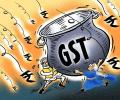
The Centre is looking to convene a meeting of the all-powerful Goods and Service Tax Council in early January. The meeting is likely to focus on rectifying the inverted duty structure for a few more items and will also serve as a platform for pre-Budget discussions between Union Finance Minister Nirmala Sitharaman and state finance ministers, Business Standard has learnt. "The current Winter Session of Parliament ends on December 23, followed by the Christmas-New Year period. "After that we would like to have a meeting of the GST Council, depending on whether there can be a quorum," a top government official said.
With days to go before Prime Minister Atal Bihari Vajpayee's visits China accompanied by a 55-member industry delegation, Confederation of Indian Industry on Monday said the country provided ample business opportunities and incentives.
Three manufacturing sectors (engineering and construction, industrial commodities and materials and commodities) created more value for its shareholders in last five years than IT or pharmaceutical companies. Engineering and construction companies, led by Larsen & Toubro and BHEL, posted a total shareholder return of 81 per cent in the last five years trailing March 31, 2007, the BCG-CII study showed.
Under the banner of the CII, domestic drug majors have approached Cabinet Secretary BK Chaturvedi for being allowed to present their views on the new pharmaceutical policy, scheduled to be discussed by the Union Cabinet on Thursday.
On the eve of Prime Minister Atal Bihari Vajpayee's visit to China, Confederation of Indian Industry has released a survey on Sino-Indian business relations, which reflect growing interest of Indian companies in the Chinese market.
Southern states will soon sell non-prescription drugs in post offices.
The Confederation of Indian Industry and ASEAN on Monday set up two task forces in pharmaceuticals and agriculture and food processing to prepare a strategy document to outline a roadmap for cooperation in these sectors.

The government hopes that the PLI schemes would provide 200,000-300,000 direct employment over five years, according to sources in the know.

American companies have been called to invest and explore business opportunities in the state

Indian firms feared they would lose business if US ratified the Trans-Pacific Partnership agreement with 11 other countries.

This is South Carolina's first trade and investment mission to India.

The former McKinsey India head is presently on board of many big Indian conglomerates.

To address the supply crunch, CII has suggested leveraging the existing excess capacity in the Indian industry; rolling back import duty hike to look for alternative sources of imports; expanding credit to manufacturing units with quick loan sanctions, and one-time emergency waiver of non-performing asset regulations for three months.

Even as India continues on the priority watch list of the Office of the US Trade Representative, strong voices from Washington, DC, have spoken out in favour of India, reports Aziz Haniffa/Rediff.com.

India could offer a train track to China to run a bullet train besides easy terms to set up industrial parks.

Ministerial consultations on, with recognition of the potential, and the need to not classify it under the same rules as for pharmaceuticals.
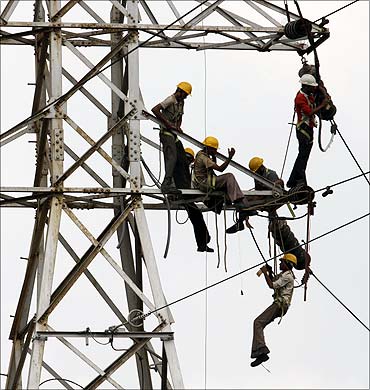
Africa is second only to West Asia as a net exporter of oil.

New government should consider reforming taxation rules.
The board would take a decision on these applications on February 20.
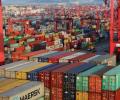
Though the government has been pushing for exports of high-value manufactured goods across major markets in place of raw materials and input goods, India's top exports to China remain in the raw materials category.
